
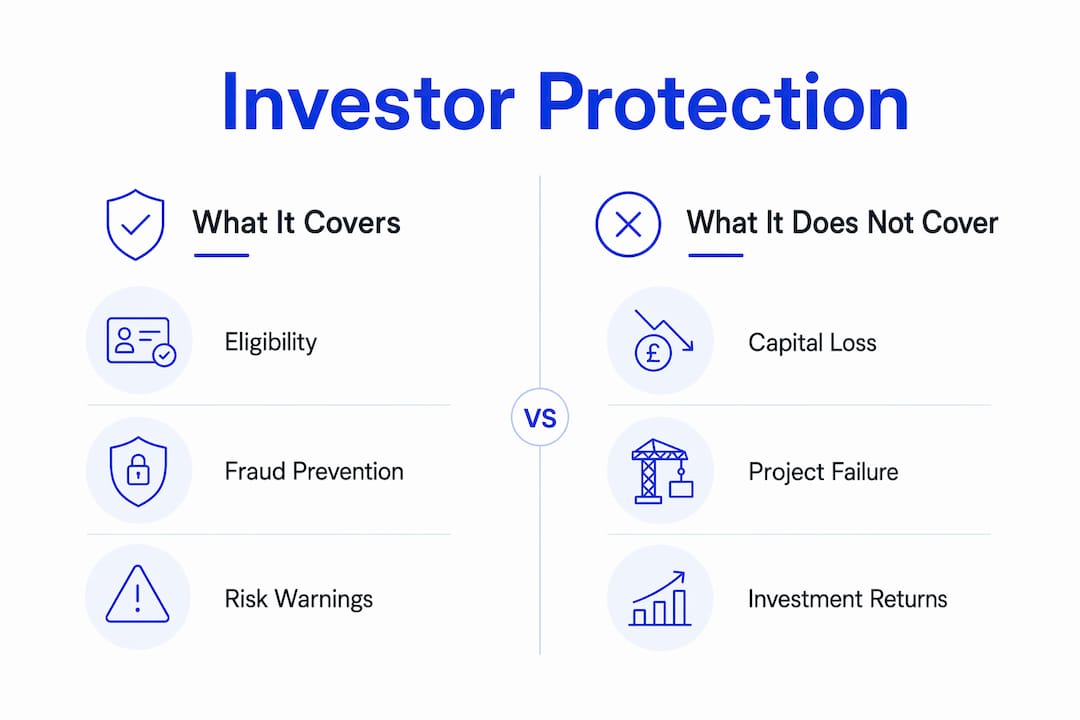
Investor protection in UK crowdfunding is a regulatory framework, not a financial guarantee. The Financial Conduct Authority (FCA) requires authorised platforms to operate transparently, deliver clear risk warnings, and conduct suitability assessments before accepting investments. Critically, losses from crowdfunding projects or borrower defaults are not covered by the Financial Services Compensation Scheme (FSCS). The 2026 Public Offer Platform (POP) regime adds further disclosure and due diligence standards. Your capital is genuinely at risk.
Key elements of investor protection in UK crowdfunding:
- ✅ FCA platform authorisation and conduct standards
- ✅ Standardised risk warnings and cost disclosures
- ✅ Investor suitability assessments before high-risk investments
- ✅ POP regime gatekeeping and due diligence requirements
- ❌ No FSCS coverage for investment losses
- ❌ No guarantee of capital preservation or returns
How the FCA's regulatory framework protects investors
The FCA sits at the centre of UK crowdfunding regulation, setting conduct standards every authorised platform must follow.
-
Platform authorisation. Every firm facilitating crowdfunding must hold the correct FCA permissions. Operating without authorisation means investors receive no regulatory protection whatsoever.
-
Financial promotion rules. Platforms must ensure all marketing is fair, clear, and not misleading, with standardised risk warnings and costs disclosed as a percentage of capital raised.
-
Suitability assessments. Before investors access high-risk, non-readily realisable securities, platforms must verify that investors understand the risks involved.
-
Loan-based and investment-based rules. Peer-to-peer lending platforms must apply client money protections under the FCA's Client Assets sourcebook (CASS), while equity platforms face additional investor categorisation requirements.
-
POP regime. The Public Offer Platform regime requires platforms acting as gatekeepers to conduct due diligence on issuers, improve disclosure quality, and prevent fraudulent offers from reaching investors.
What investor protection does not cover ⚠️
Understanding the limits of protection is just as important as knowing what exists.
- No FSCS safety net. Loan-based and investment-based crowdfunding are explicitly excluded from FSCS coverage. If a borrower defaults or a company fails, you bear that loss entirely.
- Regulation covers conduct, not performance. FCA authorisation confirms a platform meets conduct standards; it says nothing about whether any specific project will succeed.
- Total capital loss is possible. Many crowdfunded companies are early-stage, with high failure rates, which is explained in more detail in real estate crowdfunding. Even successful projects can take years to return capital.
- Suitability assessments reduce, not remove, risk. They confirm you understand the risks; they do not protect you from experiencing them.
- No guaranteed recourse if a platform fails. Investors should hold realistic expectations about recovering funds if a platform ceases trading.
How to verify a platform's legitimacy before investing ✅
Pro Tip: Always check a platform's FCA authorisation scope, not just whether it appears on the register. A firm may be authorised for payment services but not for crowdfunding investments specifically.
Use the FCA Firm Checker tool to confirm a platform holds the correct permissions for the investment type you are considering. Verify that its regulatory permissions explicitly cover the activity offered, whether equity crowdfunding, peer-to-peer lending, or securities offers via a POP. Review the platform's own due diligence disclosures and project information carefully. FCA authorisation is a baseline, not a quality stamp for individual projects. Crowdinform's regulated platform guide for 2026 helps you cross-reference platforms against these criteria efficiently.
Common risks and how FCA rules address them
| Risk | FCA Measure | What It Does Not Cover |
|---|---|---|
| Capital loss | Suitability assessments, risk warnings | Cannot prevent investment failure |
| Fraud | POP gatekeeping, due diligence rules | Cannot guarantee issuer honesty |
| Illiquidity | Disclosure requirements | Does not create a secondary market |
| Misinformation | Financial promotion rules | Does not validate project projections |
| Platform failure | Authorisation and conduct standards | No FSCS compensation for investor losses |

The POP regime's gatekeeping function specifically targets fraud by ensuring only legitimate capital-raising offers reach investors. Risk warnings and suitability checks help you understand and accept these risks consciously, rather than eliminating them.
What recourse do you have if a platform or project fails?
Recourse options in crowdfunding are narrower than many investors expect.
- No FSCS compensation applies to losses from project defaults or borrower failures.
- Financial Ombudsman Service (FOS). If a platform breaches its regulatory obligations, you can raise a complaint through the FOS. This covers conduct failures, not investment performance losses.
- Regulatory liability is scoped. Platforms are accountable where non-compliance hinders informed decisions, but investment risk/return consequences remain yours.
- Recovery is not guaranteed. Even successful enforcement action against a platform does not automatically return your invested capital.
Crowdfunding versus traditional investments: how protection differs
Crowdfunding and traditional investments operate under very different protection frameworks, and the gap matters for your portfolio decisions.
- FSCS access. Traditional products such as cash ISAs and regulated investment funds typically qualify for FSCS protection up to £85,000. Crowdfunding investments do not.
- Liquidity. Shares listed on regulated markets can usually be sold quickly. Crowdfunding investments are often illiquid for years.
- Disclosure standards. Traditional listed securities require prospectuses under strict rules. Crowdfunding disclosures, while improving under the POP regime, remain less standardised.
- Investor education burden. In crowdfunding, due diligence quality varies widely across platforms, placing a greater responsibility on you to scrutinise project information independently.
- Risk profile. Traditional investments may offer recourse and protections that crowdfunding simply cannot match. Understanding this gap is the starting point for building a balanced portfolio.
Key takeaways
UK crowdfunding investor protection is a transparency and conduct framework enforced by the FCA, not a compensation guarantee, and investors bear full capital risk on every project.
| Point | Details |
|---|---|
| No FSCS coverage | Losses from crowdfunding defaults are not compensated; capital loss is a real outcome. |
| FCA authorisation scope | Verify the platform holds permissions specifically for your investment type using the FCA Firm Checker. |
| POP regime (2026) | Requires platforms to conduct due diligence and improve disclosure before facilitating public offers. |
| Suitability assessments | Confirm you understand the risks involved but do not protect you from experiencing them. |
| Recourse is limited | Complaints via the Financial Ombudsman cover conduct failures, not investment performance losses. |


